Can Tony close before my Newburgh divorce decree deadline?
Almost always. Tony's standard close is 7-14 days. If the decree gives 30 or 60 days, that's plenty of room.
Court-ordered sale on a Orange County house? Tony closes in 7 to 14 days, the title company splits proceeds per the divorce decree, and you don't have to talk to your ex about the price. No agent, no showings, no negotiating with each other.
Divorce is hard enough without a house dragging it out. The agent showings on weekends. The arguments over price reductions. The buyer who backs out. Tony shortens the entire thing to one phone call and a 7-day close. You sell, the title company splits the money per the decree, you both walk.
Selling a Newburgh, New York house in a divorce situation is rarely about price. It's about speed, certainty, and not having to coordinate one more thing with someone you're trying to disconnect from. Tony pays cash on a 7-day close, the title company splits proceeds per the decree, and neither party has to manage showings, negotiations, or buyer drama.
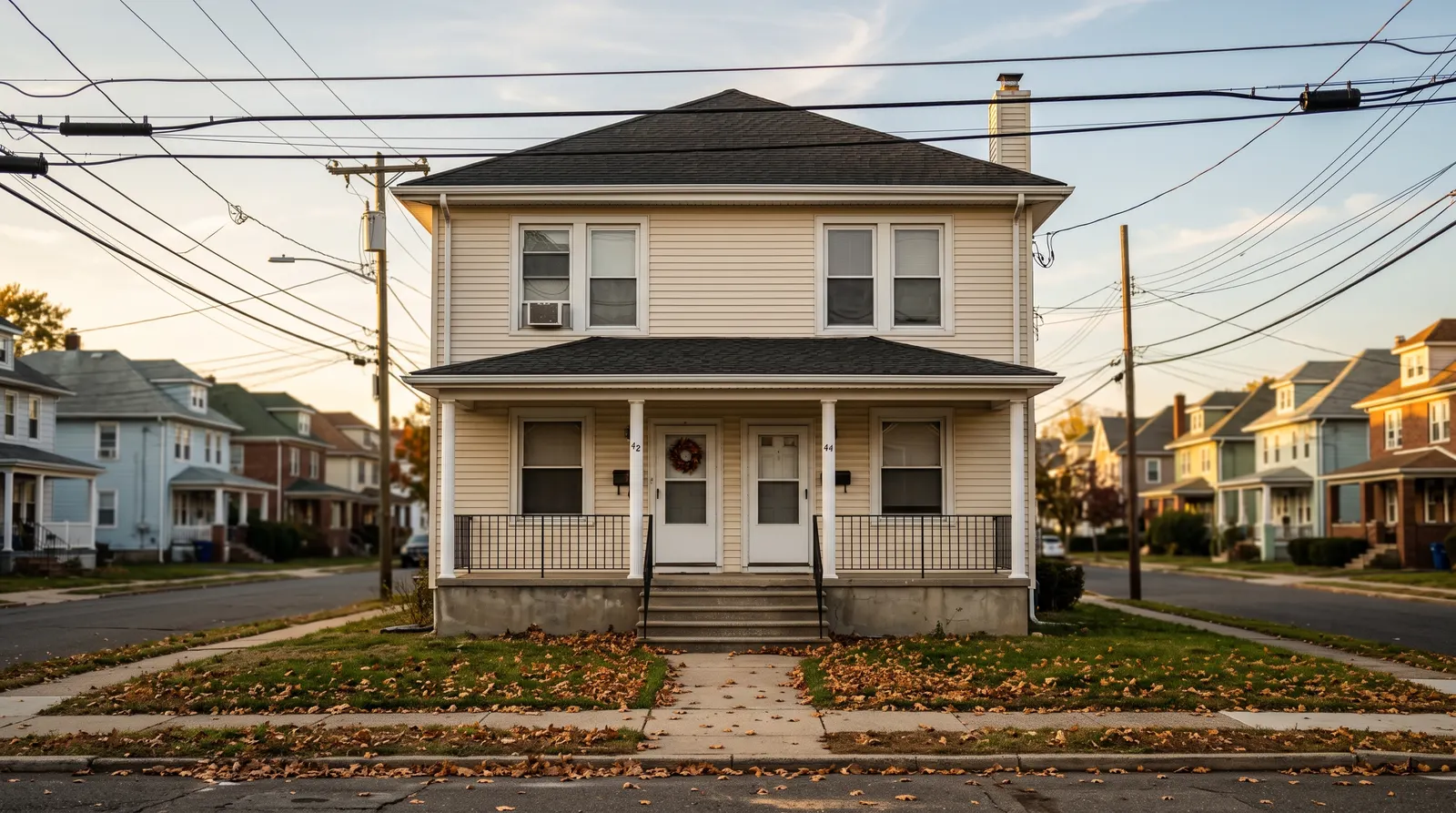
The kind of two family property Tony has bought in Newburgh.
Orange County is the Hudson Valley northwest of NYC: Newburgh, Middletown, Monroe, Goshen. Distressed urban housing in Newburgh and suburban estates further west.
Orange County tax rates are 2.5-3.5% on the higher end.
§·· / Schedule
Tell Tony where the house is and what shape it's in. Get a cash number on the same call. Pick a closing date.
7 days a week, 8 AM to 9 PM Eastern.
If the Newburgh divorce is contentious and the spouses can't agree on a price, Tony's offer is often acceptable to a judge as a fair-market cash exit, especially when listing has been tried unsuccessfully. Tony's title company has worked with NJ and NY family-law attorneys on dozens of these.
Newburgh has historic brick row houses and Victorian houses, many in distressed condition. Tony buys condemned, abandoned, and tax-foreclosure properties. The East End Historic District — one of the largest in New York State — is 1840s–1900s brick Italianate and Second Empire rowhouses and townhouses on the hill above the Hudson, many converted to three- and four-family apartments and many vacant; the West End and the Heights are 1900s–1920s frame houses and 1950s capes; and Broadway, one of the widest main streets in the state, is mixed-use buildings with apartments over empty storefronts.
Newburgh sellers call Tony about a brick rowhouse on Grand or Liberty Street that a family has owned since the 1960s and can no longer keep up — a slate roof, a failed boiler, a City building-department order, and a tenant who stopped paying. Others are out-of-town investors who bought during a Brooklyn-to-Newburgh wave, ran out of money mid-renovation, and now owe back taxes to the City and the County. Heirs to a West End frame house often live in New Jersey or the Carolinas and don't want to manage a vacant property that the City has flagged. Tony buys the rowhouse occupied, the half-done renovation with its open permits, and the vacant house with the violations — one number on the phone, closing on your date.
Newburgh sellers pay the 0.4% New York State transfer tax; Tony nets it into his offer. Orange County closings run on an updated abstract of title, deeds record with the Orange County Clerk in Goshen, and estates go through Orange County Surrogate's Court there. The City of Newburgh forecloses on delinquent city taxes and Orange County holds its own auction for county taxes — a cash closing that pays the arrears stops both. Historic-district buildings carry Architectural Review Commission rules on exterior work, which affect Tony's renovation, not your sale.
Every cash buyer, Tony included, starts from the same three numbers: what the house would sell for fully renovated, what it costs to get it there, and how long that takes. The offer is that finished value minus the repairs, minus the buyer's resale costs and margin. In practice that lands most cash offers somewhere around 70–85% of the renovated value, less repairs. The honest comparison is not against a renovated house's list price — it is against what you would actually net from a NY listing after commission, repairs, and months of carrying costs.
| Line item | List with an agent | Sell to Tony |
|---|---|---|
| What the house would sell for fully renovated | $400,000 | $400,000 |
| Repairs a retail buyer's lender will demand | − $45,000 | Tony's problem |
| Agent commission (5–6%) | − $20,000 to $24,000 | $0 |
| Inspection credits, seller closing costs, concessions | − $8,000 to $12,000 | $0 |
| Taxes, insurance, mortgage, utilities while you wait (3–6 months) | − $9,000 to $15,000 | $0 |
| Time to cash in hand | 4 to 7 months | 7 to 14 days |
| What you actually walk away with | ≈ $305,000 to $318,000 | Tony's number, in full, on your date |
Whether Tony's number beats that listing net depends on the house. On a move-in-ready home in a hot NYmarket it usually will not, and Tony will tell you to list. On a house that needs work, has tenants, sits in an estate, or carries violations — the houses retail buyers cannot finance — it is often close, and the seven-day timeline is the difference. Call 1-908-768-4759, get the number, and compare it yourself.
Buying since 2018· every county in New Jersey and New York · no commissions or fees · every closing at a licensed NY title company.
Contact
Drop your number and Tony reaches out about your Newburgh property within an hour.
Almost always. Tony's standard close is 7-14 days. If the decree gives 30 or 60 days, that's plenty of room.
Tony's offer is fair-market cash. Many spouses use Tony's number as the neutral fact that resolves the dispute. If one spouse refuses to sign, that's a court issue, not Tony's.
Yes. The title company follows the decree's instructions exactly. Both spouses get separate wires per the agreed split.
No. NJ and NY remote notarization makes it routine to sign separately. Most Newburgh divorce sellers don't see each other through the entire closing.
Tony buys it occupied if the spouses agree. Or the move-out can be timed to the closing date. Both work.
Yes. Vacant, boarded, fire-damaged, and City-flagged rowhouses in the East End Historic District are a regular Tony purchase, along with occupied three- and four-families on Grand, Liberty, and Lander Streets, frame houses in the West End and the Heights, and mixed-use buildings on Broadway. One call with the address gets you a number.
Yes, occupied or empty. City of Newburgh Code Compliance violations, an unsafe-building order, and rental-registry issues transfer to Tony at closing, and he deals with them after he owns it. Fines that have become liens are paid from the proceeds. You don't need to make repairs or bring the building into compliance before selling.
Yes. Open permits, a gutted interior, a contractor's lien, and back taxes are all things Tony has closed through. Liens and arrears are paid from the proceeds, the open permits become his to close out with the City, and he prices the building on what's left to do. He closes on your schedule and wires the balance.
Usually, if you call before the foreclosure is final. Tony's title company orders the City and County tax payoffs, the arrears come out of the proceeds at closing, and his cash closing in about a week keeps you ahead of the deadline. After the City takes title, the equity is gone — so call the day the notice arrives.
Court deadline on the Newburgh sale? Tony closes faster than any agent can list. 1-908-768-4759.
§·· / Schedule
Tell Tony where the house is and what shape it's in. Get a cash number on the same call. Pick a closing date.
7 days a week, 8 AM to 9 PM Eastern.
Different situation? Tony also handles these Newburgh cases:
← All cash buyer options for Newburgh·Orange County·New York